How a DPIA is done in LegisGate
Six steps. The first three happen without you.
You add the AI use case and answer about 15 minutes of intake. Everything below follows from those answers, and nothing is asked twice.
Step 01The determination says whether a DPIA is called for
Article 35 applies on conditions, and plenty of AI use cases do not meet them. The determination tests yours against those conditions. If a DPIA is not required, you have the dated record saying so, which is the document you actually needed.
Step 02The draft opens on the use case
Where a DPIA is required, it is opened as a draft when the determination runs. There is nothing to request and nothing to buy. There is one DPIA for each AI use case, covering the EU, the UK, or both, as the use case reaches them; the version you choose decides which authority’s template it follows.
Step 03Our half is written
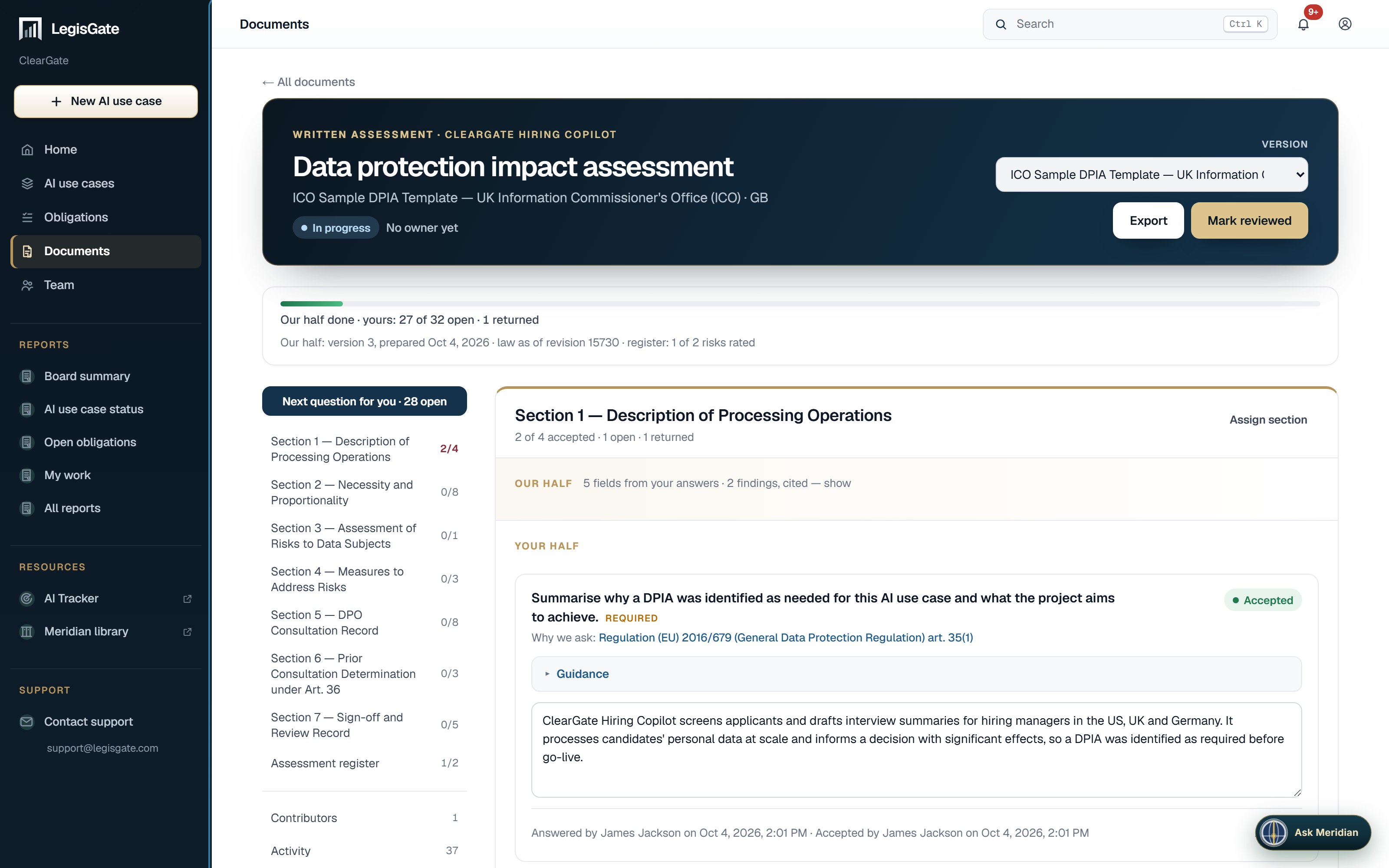
Each section opens with what your intake already answered and the findings that belong to that section, each cited to the provision it comes from, and the risk statements where the section has them. That half is read-only.
Step 04You answer your half
Your half is laid out as guided questions, section by section: the description of the processing, necessity and proportionality, the risks to data subjects, the measures against them, the DPO consultation, the prior-consultation determination, and the sign-off. Each question shows why it is asked, with the article that requires it linked to the source text, and a Guidance block quoting the ICO.
Step 05Hand a question to the person who knows
Assign a question, or a whole section, to a teammate with a due date, or invite a contributor by email for the questions that are theirs. A contributor creates a password from the link and sees only the questions assigned to them. Each answer is Open, Answered, In review, then Accepted, or Returned with a note.
Step 06You rate the risks, export, and record the review
The assessment register lists each risk the determination raised. Your organisation rates it, before and after the measures against it, and a measure you commit to becomes an obligation with an owner and a due date. The DPIA exports as a Word document in the ICO sample template, the EDPB template structure, CNIL and other versions, with a status line on its cover saying how many questions are accepted and whether it has been reviewed. Mark reviewed records who reviewed it and when; it does not say the assessment is sufficient.
Monitoring is included and automatic: when the law behind a question changes, that question is flagged, and the activity log records who answered, accepted, assigned and exported.
Your first five AI use cases are free, with everything included: the laws, the obligations, the written assessments and monitoring. No card. More than five is a subscription.