The determination says whether a DPIA is called for
Article 35 of the UK GDPR applies on conditions. The determination tests your AI use case against them. If a DPIA is not required, you have the dated record saying so.

LegisGate · UK DPIA
The ICO publishes DPIA guidance and a sample template, which makes the UK the straightforward case. In LegisGate the DPIA opens when the determination calls for one, your half is laid out as guided questions with the ICO’s own guidance beside them, and it exports as a Word document in the ICO sample template.
How a UK DPIA is done in LegisGate
Add the AI use case and answer fifteen minutes of intake. Everything below follows from those answers, and nothing is asked twice.
Article 35 of the UK GDPR applies on conditions. The determination tests your AI use case against them. If a DPIA is not required, you have the dated record saying so.
Where a DPIA is required, it opens as a draft the moment the determination runs. Choose the ICO sample template as its version. If the use case also reaches the EU, the same DPIA covers both.
Each section opens with what your intake already answered and the findings that belong to that section, each cited to the UK GDPR or the DPA 2018. That half is read-only.
Each guided question says why it is asked, and its Guidance block quotes the ICO’s DPIA guidance and sample template on that point, with the licence they are published under. We quote it. We do not turn it into advice.
Assign a question, or a whole section, to a teammate with a due date, or invite a contributor by email for the questions that are theirs. A contributor creates a password from the link and sees only the questions assigned to them. Each answer is Open, Answered, In review, then Accepted, or Returned with a note.
The assessment register lists each risk the determination raised, and uses the likelihood and severity scale from the ICO’s sample template. Your organisation gives the rating, before and after the measures against it. The DPIA exports as a Word document in the ICO sample template, with a status line on its cover. Mark reviewed records who reviewed it and when; it does not say the assessment is sufficient.
Monitoring is included and automatic: when the law behind a question changes, that question is flagged, and the activity log records who answered, accepted, assigned and exported.
Your first five AI use cases are free, with everything included: the laws, the obligations, the written assessments and monitoring. No card. Past five, it is a subscription.
What it looks like
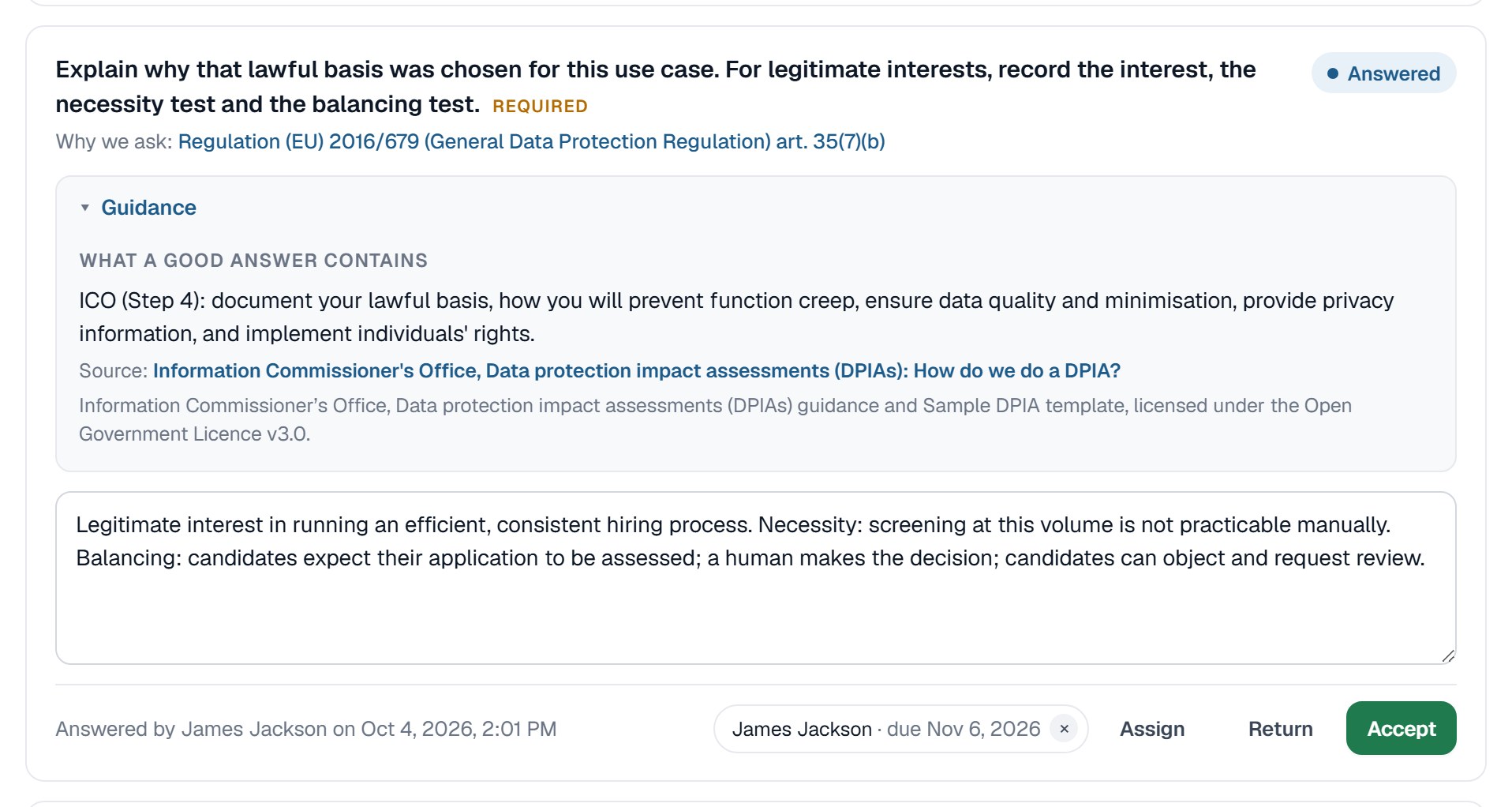
A question in your half, opened: the article that requires it, the ICO’s guidance with its source and licence, your answer, and who it is assigned to.
The two halves
The split is not arbitrary. One side has an answer that can be checked against a source. The other has a defensible answer that depends on your organisation and its appetite for risk.
| ICO section | Our half | Your half |
|---|---|---|
| Describe the processing | Nature, scope, context and purposes, drawn from your intake | Anything the intake could not know about internal workflow |
| Consultation process | Whether the shape of this processing points toward consulting data subjects | Who you consulted, or the reasoned decision not to |
| Necessity and proportionality | The lawful-basis framing and the questions the section expects answered | The answer. The paragraph the assessment turns on |
| Identify and assess risks | The risks the determination raised, each cited to where it comes from | Likelihood and severity for your population, in the assessment register |
| Identify measures to reduce risk | The controls the obligations expect, each tied to its provision | Which you actually operate, and what you will do about the rest |
| Sign off and record outcomes | — | All of it. The DPO’s advice and the controller’s decision |
We bring the regulatory intelligence and the intake. You bring the privacy and legal judgment for your use case and organization. The document is built to hold both.
The division of labourWhat this is not. LegisGate produces regulatory intelligence and assessment-preparation materials. Nothing we produce is legal advice, a legal opinion, a certification, or a determination of compliance, and no document we deliver satisfies a legal obligation on its own. Sufficiency is determined by your counsel. A completed DPIA from us does not satisfy Art. 35. It is the document your controller and DPO complete and sign. The ICO’s template is a sample, not a mandatory form.

The half that is yours
It depends on facts only your organisation knows, and it has to be defended by the people who made the decision. We write everything around it.