
A chatbot that talks to patients
A symptom-checking chatbot is a medical device question before it is a chatbot question.
A chatbot on a patient portal suggests how urgently someone should be seen. That one sentence pulls in device regulation, the EU AI Act's high-risk tier and the incident duties of two data protection laws. This page shows the determination for one such tool, used in Germany and the United Kingdom.
The example
Patient Triage Chat: a generative chatbot on the patient portal.
It answers patients' questions about their symptoms, asks follow-up questions and suggests how urgently to be seen: self-care, routine appointment, same-day or emergency. A triage nurse sees every suggestion marked same-day or emergency.
What the digital health lead asks
Device, AI Act, and what to do when it goes wrong.
Each obligation is quoted as the platform renders it for this tool, with its citation.
Is a symptom checker a medical device?
For this tool the determination says the UK regulator's AI-as-a-medical-device rules apply. The gate, in the product's words, is whether the AI makes, supports or influences clinical decisions. MHRA AIaMD returned seven obligations, and they read like a device file: classification, UK marking, post-market surveillance, and the incident clocks a safety officer lives by: two days, ten days, fifteen days.
- Classification of general medical devicesMedical Devices Regulations 2002 (SI 2002/618) reg. 7MHRA AIaMD
- UK marking of general medical devicesMedical Devices Regulations 2002 (SI 2002/618) reg. 10MHRA AIaMD
- Initial reporting of serious incidents — serious public-health threat (2 days)Medical Devices Regulations 2002 (SI 2002/618) reg. 44ZH(4)MHRA AIaMD
- Initial reporting of serious incidents — death or unanticipated serious deterioration (10 days)Medical Devices Regulations 2002 (SI 2002/618) reg. 44ZH(5)MHRA AIaMD
- Post-market surveillance systemMedical Devices Regulations 2002 (SI 2002/618) reg. 44ZEMHRA AIaMD
What does the EU AI Act ask of a triage chatbot?
The tier shown is high-risk. Three obligations are in force now: a screen against the prohibited practices before anything else, the art. 4a safeguards if special-category data is used to detect bias, and AI literacy for the staff who operate it.
- Prohibited AI practices — screen the deployment against art. 5 and refrain (Regulation (EU) 2024/1689 art. 5)Regulation (EU) 2024/1689 (Artificial Intelligence Act) art. 5EU AI Act
- Confirm the art. 4a safeguards if special-category data is processed to detect or correct bias in Patient Triage Chat (art. 4a)Regulation (EU) 2024/1689 (Artificial Intelligence Act) art. 4aEU AI Act
- EU AI Act art. 4 — confirm AI literacy for staff operating this systemRegulation (EU) 2024/1689 (Artificial Intelligence Act) art. 4EU AI Act
The nurse sees the urgent cases. Is that the human review the law wants?
That is the question the determination puts on the list rather than answers for you: GDPR returned a meaningful-human-review obligation for the tool's automated decisions, and UK GDPR its art. 22C safeguards. Whether a nurse reviewing the same-day and emergency suggestions meets them is for your counsel; the obligation is cited so the question is not missed.
- Give a meaningful human review to Patient Triage Chat's automated decisionsRegulation (EU) 2016/679 (General Data Protection Regulation) art. 22GDPR
- Give art. 22C safeguards to Patient Triage Chat's solely automated significant decisionsUK GDPR (assimilated Regulation (EU) 2016/679) Arts. 22A-22DUK GDPR
- Identify an art. 9(2) condition before Patient Triage Chat processes special-category dataRegulation (EU) 2016/679 (General Data Protection Regulation) art. 9GDPR
A patient's symptoms leak. Who is told, and how fast?
GDPR returned fourteen obligations and UK GDPR ten. Two of them are the breach clocks: the supervisory authority within 72 hours, and the people affected when the risk to them is high. NIS2 adds the incident timelines and puts accountability on the management body.
- Notify the supervisory authority of a breach touching Patient Triage Chat within 72 hoursRegulation (EU) 2016/679 (General Data Protection Regulation) art. 33GDPR
- Tell affected individuals about a high-risk breach touching Patient Triage ChatRegulation (EU) 2016/679 (General Data Protection Regulation) art. 34GDPR
- Incident reporting timelinesDirective (EU) 2022/2555 art. 23NIS2
- Management-body accountabilityDirective (EU) 2022/2555 art. 20NIS2
What did the determination leave open?
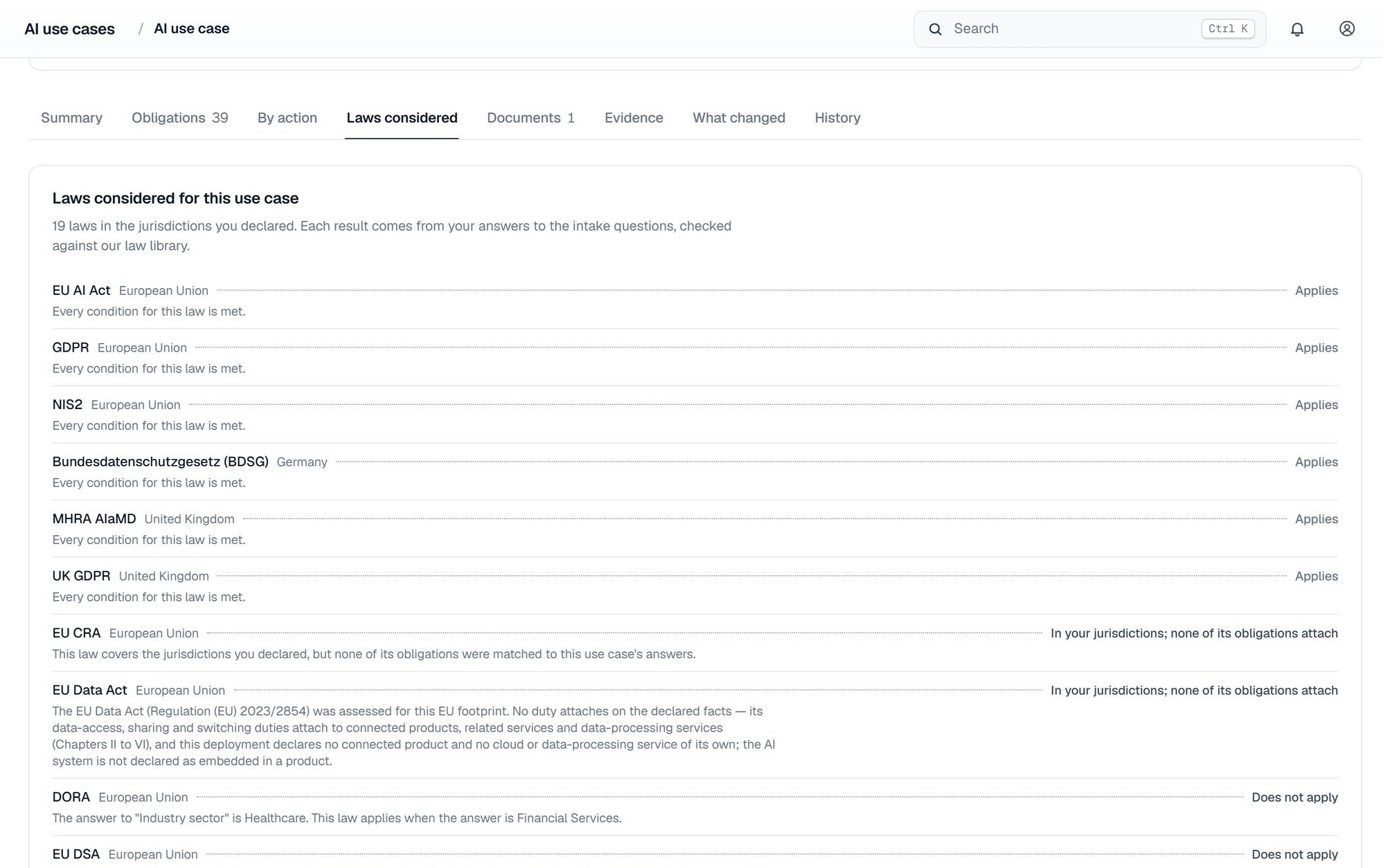
Four laws were recorded as not determined because a question was not answered: the EU-U.S. Data Privacy Framework, the UK ATRS, UK BCRs and the UK IDTA. Each stays marked that way, with the question named on its row, rather than silently as no.
Every law that returned obligations
Six laws, thirty-nine obligations.
Both EU and UK data protection law reach the tool, because the portal serves patients in Germany and in the United Kingdom. Germany adds its own data protection officer threshold.
- GDPREuropean Union · 14 obligations
- UK GDPRUnited Kingdom · 10 obligations
- MHRA AIaMDUnited Kingdom · 7 obligations
- NIS2European Union · 4 obligations
- EU AI ActEuropean Union · 3 obligations
- Bundesdatenschutzgesetz (BDSG)Germany · 1 obligation
Also in those jurisdictions, with no obligation attached to this tool: the EU Cyber Resilience Act and the EU Data Act. 7 of the 19 laws did not apply, each recorded with the reason. A further 294 laws outside the declared jurisdictions were also evaluated. This example is a healthcare chatbot; the result for a chatbot in another sector depends on its own answers. The figures are as recorded on October 7, 2026 and move when the law library or the answers change and the AI use case is checked again. Your result depends on your own answers.
Where your judgment comes in
LegisGate prepares the work. Your counsel decides.
A determination tells you what attaches to an AI use case. It does not tell you that you have met the law. Whether it is sufficient is for your counsel.

Getting started
Your first five AI use cases are free.
Add your own AI use case, answer the intake form and read the determination.