
AI in credit decisions
A payment-plan scoring tool can be a credit decision.
Here is what the determination shows for one. A health system's billing office uses a vendor model to score applications for payment plans and medical credit lines. A few intake answers, that the tool makes or influences credit decisions, that the decision domain is credit, that it reads a consumer reporting agency's report and the industry declared, bring in the consumer-credit laws beside the health-data ones. This page shows the determination for that tool, and is careful about what it does not establish.
The example
Patient Financing Eligibility Assistant: a vendor model the billing office uses.
It scores a patient's application for a hospital payment plan or a medical credit line. It reads the application, the patient's account history and a consumer credit report, and recommends approve, decline or refer. A billing specialist makes every final decision and sends any notice of an adverse decision. It is used in the United States, California and New York. The industry declared for this use case is financial services, consumer lending and credit.
What the revenue-cycle director asks
Credit law, consumer reports and patient data, answered from the determination.
Sixteen of the thirty-two shown obligations are quoted below as the platform renders them for this tool, with their citations. Where the determination establishes less than the question asks, the page says so.
Does the tool make a credit decision?
The intake asked whether the AI makes or influences credit decisions, and the answer was yes: scoring, underwriting, approval or denial, pricing, or adverse action. That answer, with the US footprint, selects ECOA, which returned four obligations, including the adverse-action notice with specific reasons even when a model decided. One limit to read with them: each stored ECOA duty says "Where [the tool] is used by a creditor ...", and the intake does not ask whether the organization is a creditor. The product establishes the tool-level fact; whether a payment plan makes a health system a creditor is for counsel.
- Notify adverse action within 30 days with specific principal reasons, even when a model decided12 C.F.R. § 1002.9ECOA
- Evaluate applications without taking a prohibited basis into account; use age only as Reg B permits12 C.F.R. § 1002.6ECOA
- Do not discriminate on a prohibited basis in any aspect of a credit transaction, or discourage applicants12 C.F.R. § 1002.4ECOA
We pull a credit report. What does FCRA add?
FCRA is selected because the decision domain is credit, the footprint is US and the tool uses a consumer reporting agency's report. Five obligations are shown. One is written for a user of consumer reports: the adverse-action notice. The other four run along the chain: accuracy and dispute investigation as duties of the reporting agency, inaccurate inputs as a duty of a furnisher, and a classification to make if the vendor itself aggregates consumer data. The determination lists them because the report is used; it does not establish that the health system or its vendor is a reporting agency or a furnisher.
- Requirements on users of consumer reports — adverse-action notices15 U.S.C. § 1681m (FCRA § 615 — requirements on users of consumer reports)FCRA
- Accuracy — reasonable procedures to assure maximum possible accuracy15 U.S.C. § 1681e(b) (FCRA § 607(b) — maximum possible accuracy)FCRA
- Dispute investigation15 U.S.C. § 1681i (FCRA § 611 — procedure in case of disputed accuracy)FCRA
- FCRA — AI vendor aggregating consumer data for downstream FCRA permissible-purpose use without CRA compliance15 U.S.C. § 1681a (FCRA § 603 — definitions)FCRA
It is still patient data. What does that add?
The declared data types include protected health information and financial data, so HIPAA returned nine obligations and HITECH one: the business associate agreement, the administrative, physical and technical safeguards over the ePHI inside the system, the minimum-necessary standard and the patient's right to electronic copies. These are not specific to patient financing; they follow the data.
- Check the business associate agreement for Patient Financing Eligibility Assistant against 45 C.F.R. § 164.504(e)45 C.F.R. § 164.502(e)HIPAA
- Minimum necessary - limit ePHI uses, disclosures, and requests to the minimum needed (45 CFR § 164.502(b))45 C.F.R. § 164.502(b)HIPAA
- Strengthened right of access — electronic copies45 C.F.R. § 164.524HITECH
What does California add for a credit model?
The determination shows six obligations under the automated decision-making regulations: a risk assessment before the tool is used for a significant decision, with the vendor's logic and outputs carried into it, and the assessment information submitted to the Privacy Protection Agency; and, from 2027, a pre-use notice, an opt-out or human appeal, and answers to access requests. Under the CCPA it shows six more, among them a risk assessment before sensitive personal information is processed and the service-provider terms in the vendor agreement.
- Conduct a risk assessment before using Patient Financing Eligibility Assistant as ADMT for a significant decision (11 CCR § 7150(b)(3))11 CCR § 7150(b)(3)California ADMT
- Risk assessment information must be submitted to the California Privacy Protection Agency on the regulatory schedule (11 CCR § 7157)11 CCR § 7157California ADMT
- Opt-out of ADMT, or a qualifying human appeal (by January 1, 2027)11 CCR § 7221California ADMTfrom January 1, 2027
- Complete a California Consumer Privacy Act risk assessment before Patient Financing Eligibility Assistant processes sensitive PICal. Code Regs. tit. 11, § 7150(b)(2)CCPA / CPRA
- Confirm the Patient Financing Eligibility Assistant vendor agreement meets the required service-provider or contractor termsCal. Civ. Code § 1798.100(d)CCPA / CPRA
What is not shown, and why?
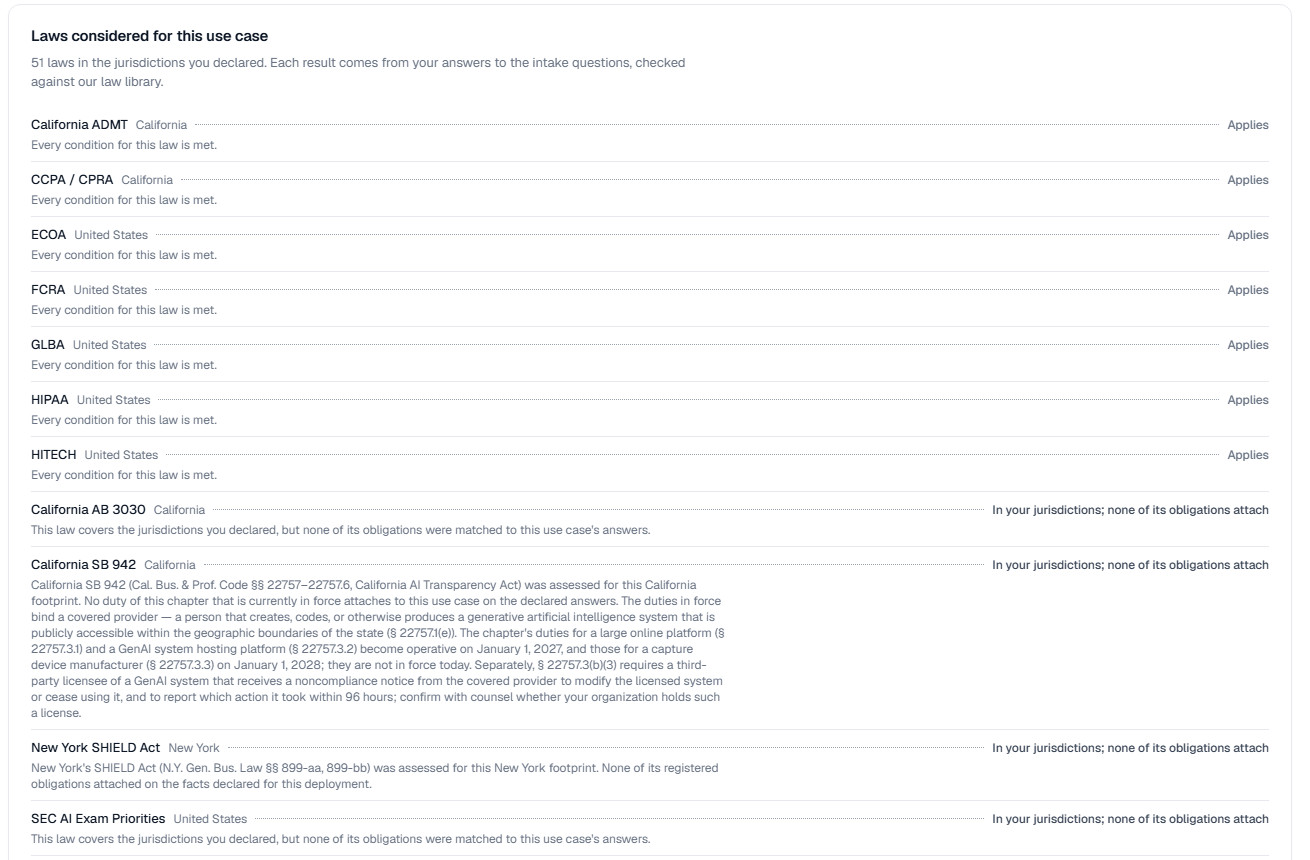
Four of the eleven selected laws show no obligation: California AB 3030, California SB 942, the New York SHIELD Act and the SEC's AI examination priorities. On all four, obligations exist and are held pending citation verification, and one AB 3030 question was not answered; none is shown, which is not the same as none existing. Across this determination 49 obligations are held that way, including 5 under ECOA and 2 under FCRA, so the lists above are what is currently shown, not everything the law may ask. GLBA was selected on a derived fact, from the credit-decision answer and the declared industry, while the declared institution class is not applicable; one GLBA duty is shown.
- Protection of nonpublic personal information — GLBA § 501 security and confidentiality mandate (15 U.S.C. § 6801)15 U.S.C. § 6801GLBA
Every law that returned obligations
Seven laws, thirty-two obligations.
Eleven laws were selected for this tool; seven returned obligations that are shown, and four returned none that are shown.
- HIPAAUnited States · 9 obligations
- California ADMTCalifornia · 6 obligations, 3 from January 1, 2027
- CCPA / CPRACalifornia · 6 obligations, 1 from January 1, 2027
- FCRAUnited States · 5 obligations
- ECOAUnited States · 4 obligations
- GLBAUnited States · 1 obligation
- HITECHUnited States · 1 obligation
Selected with no obligation shown: California AB 3030, California SB 942, New York SHIELD Act, SEC AI Exam Priorities. Of the 51 laws considered in the declared jurisdictions, 40 did not apply, each recorded with the reason; a further 262 laws outside those jurisdictions were also evaluated. The EU AI Act is recorded as not in scope because no EU jurisdiction was declared. The figures are as recorded on October 7, 2026 and move when the law library or the answers change and the AI use case is checked again. Your result depends on your own answers.
Where your judgment comes in
LegisGate prepares the work. Your counsel decides.
A determination tells you what attaches to an AI use case. It does not tell you that you have met the law. Whether it is sufficient is for your counsel.

Getting started
Your first five AI use cases are free.
Add your own AI use case, answer the intake form and read the determination.